Example answers tailored for new graduates, mid-senior professionals, and executives
Mistakes to avoid so you don’t fall into common interview traps
How to adapt your answers for in-person, video, and AI-screened interviews
A 5-step readiness checklist to feel calm, clear, and confident before every interview
Whether you’re a new graduate finding your first opportunity, a mid-senior professional in transition, or a retiring executive exploring reinvention, job interviews can feel like high-stakes auditions. Add in AI screenings, video interviews, and global remote hiring, and the stakes feel even higher.
But the good news is that once you understand why these common job interview questions are asked, how to frame your answers, and how to adapt for your career stage and interview format, the pressure eases.
Let’s map this out with no fluff, no clichés — just actionable strategies, examples, and mistakes to avoid so you can answer with confidence in any interview format.
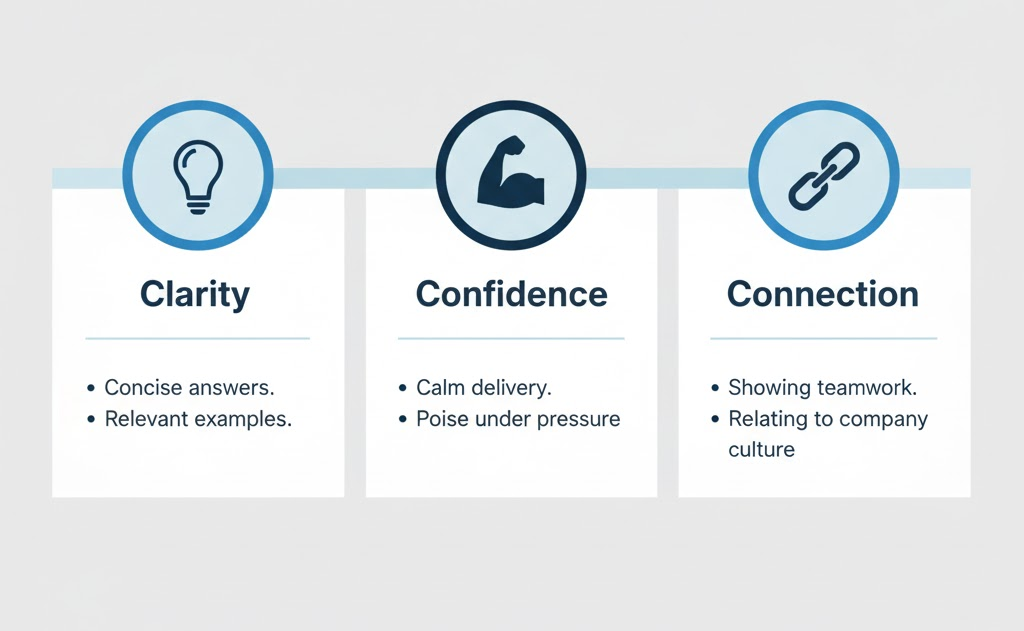
The 3 C’s of Interviewing
Before we dive into specific questions, keep this in your back pocket:
Clarity – concise, relevant answers.
Confidence – calm delivery, even under pressure.
Connection – showing you’re not just qualified, but a great teammate.
Q1. Why did you apply for this position?
This is about motivation.
Interviewers want to know: Did you do your homework, or are you just mass-applying?
A strong answer ties the role’s responsibilities and the company’s mission directly to your career goals.
Framework at a Glance
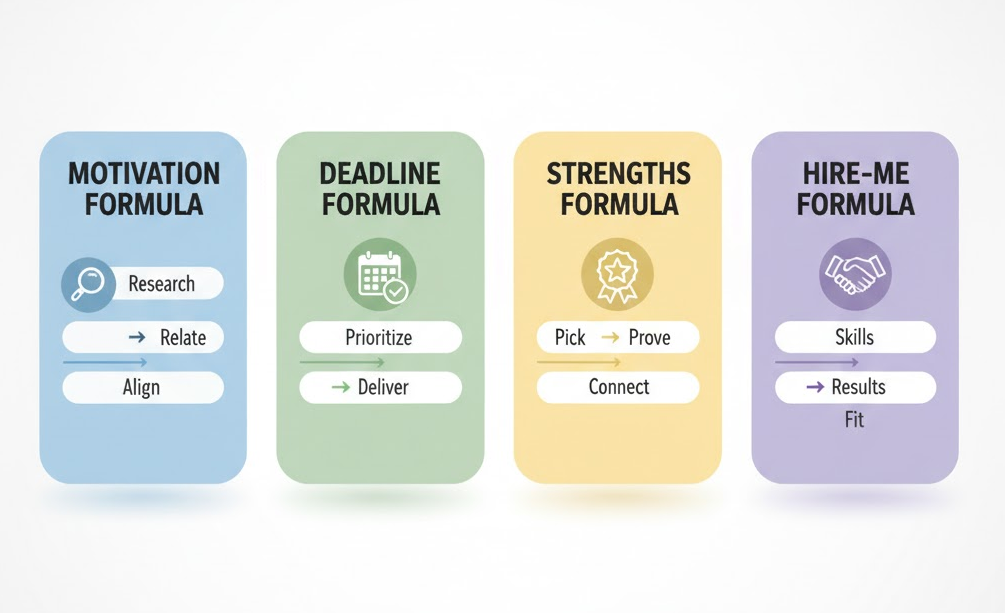
Motivation Formula: Research → Relate → Align
Research: Show you understand the company.
Relate: Connect their work to your skills/values.
Align: Explain why this role is your next step.
Good Example (Mid-Senior):
“Your commitment to renewable energy aligns with my ESG background. I applied because I want to contribute to scaling these projects globally.”
Bad Example:
“Honestly, I just need a job right now.”
Mistakes to Avoid:
Being vague or generic (“I just liked the posting”).
Talking only about salary/benefits.
Forgetting to link your motivation to the company’s mission.
Variations
By Career Stage
Executive: tie to strategy + legacy.
New Grad: tie to learning + mission.
Mid-Senior: tie to expertise + growth.
By Interview Type
In-Person: add energy, show enthusiasm.
Video: 45–60 sec, clear delivery.
AI Screening: 30 sec, keyword-rich.
Q2. Explain how you manage tight deadlines at work.
This tests resilience and prioritization.
The key is not just “I work hard” but a system: how you organize, delegate, or adapt under pressure.
Framework at a Glance
Deadline Formula: Prioritize → Plan → Deliver
Prioritize: Clarify what’s critical.
Plan: Use tools, checkpoints.
Deliver: Show measurable results.
Good Example (Mid-Senior):
“I break deadlines into milestones. For a recent product launch, I set daily sprints and stakeholder updates. We shipped two days early.”
Bad Example:
“I just stay late and hope for the best.”
Mistakes to Avoid:
Bragging about working nonstop without a method.
Blaming others for missed deadlines.
Forgetting to mention measurable results.
Variations
By Career Stage
New Grad: show time management with coursework/projects.
Mid-Senior: show team coordination.
Executive: show crisis leadership.
By Interview Type
In-Person: emphasize calm presence.
Video: short, structured story.
AI Screening: <40 sec, keyword “prioritize.”
Q3. What are your biggest strengths and why?
This isn’t about listing traits or rattling off adjectives.
Connect each strength to proof and explain why it matters in the role.
Framework at a Glance
Strengths Formula: Pick → Prove → Connect
Good Example (Mid-Senior):
“One of my strengths is data storytelling. At my last role, I simplified dashboards for executives, cutting decision time by 40%.”
Bad Example:
“I’m a perfectionist.”
Mistakes to Avoid:
Listing generic traits without evidence.
Choosing strengths unrelated to the role.
Overloading with too many strengths.
Variations
By Career Stage
New Grad: highlight adaptability, learning.
Mid-Senior: emphasize technical or leadership skills.
Executive: show strategic vision and influence.
By Interview Type
In-Person: use storytelling.
Video: 1–2 concise examples.
AI Screening: keyword-heavy, 30–45 sec.
Q4. Why do you think you’re the right candidate for this position?
This is your elevator pitch.
Think: “Here’s why I can do this, and why I’ll thrive here.”
Framework at a Glance
Hire-Me Formula: Skills → Results → Fit
Good Example (Executive):
“I bring 15 years of experience in digital transformation, a proven record of driving 25% cost reductions, and a leadership style that fosters innovation and collaboration. That makes me confident I can deliver impact in this role.”
Bad Example:
“Because I really want it.”
Mistakes to Avoid:
Repeating your resume line by line.
Sounding desperate (“I’ll do anything”).
Overselling without evidence.
Variations
By Career Stage
New Grad: focus on transferable skills + eagerness.
Mid-Senior: highlight proven results.
Executive: emphasize strategic leadership.
By Interview Type
In-Person: deliver with presence + eye contact.
Video: keep it 60–90 sec, look at the camera.
AI Screening: 30–40 sec, keyword-rich.
Q5. Why did you leave your previous position?
This reveals career transitions and potential red flags.
Keep it professional, future-focused, and positive.
Framework at a Glance
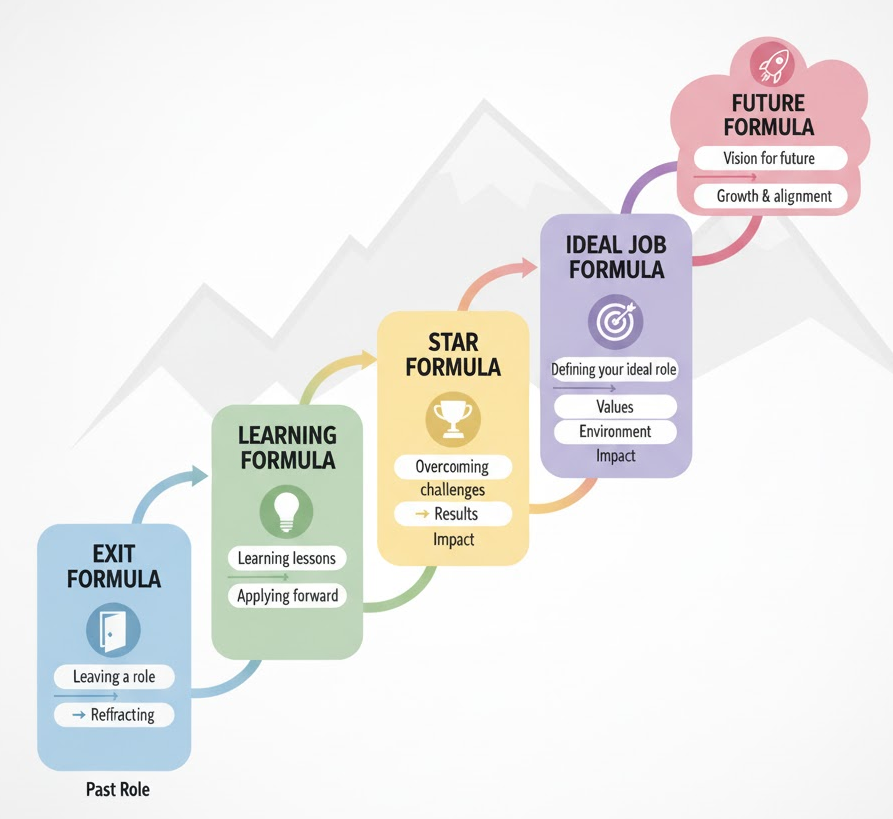
Exit Formula: Reason → Reflection → Reframe
Reason: Be honest but tactful.
Reflection: Share what you learned.
Reframe: Tie to this new opportunity.
Good Example(Mid-Senior):
“I left because growth opportunities had plateaued. I learned a lot about stakeholder management and now I’m ready to apply those skills in a larger, global role.”
Bad Example:
“My boss was terrible.”
Mistakes to Avoid:
Criticizing managers or colleagues.
Over-explaining personal reasons.
Sounding unfocused about next steps.
Variations
By Career Stage
New Grad: not usually relevant — focus on internships/projects ending.
Mid-Senior: career growth or new challenges.
Executive: strategy shifts, legacy work completed.
By Interview Type
In-Person: maintain a calm, professional tone.
Video: concise, neutral.
AI Screening: <30 sec, neutral phrasing.
Q6. Where do you see yourself in the future?
Interviewers want ambition + alignment.
Don’t promise the moon; instead, show a growth path that ties to the company’s direction.
Framework at a Glance
Future Formula: Growth → Alignment → Flexibility
Good Example of STAR Method (New Grad):
“In the next few years, I’d like to deepen my technical expertise, contribute to cross-functional projects, and grow into a team lead role within this company.”
Bad Example:
“I might start my own company.”
Mistakes to Avoid:
Being vague or evasive.
Overpromising unrealistic outcomes.
Suggesting you’ll leave quickly.
Variations
By Career Stage
New Grad: emphasize learning + contribution.
Mid-Senior: career progression (manager → director).
Executive: strategic leadership, mentoring.
By Interview Type
In-Person: conversational, confident.
Video: 45–60 sec, positive tone.
AI Screening: <40 sec, keywords like “growth,” “impact.”
Q7. What did you learn from your previous job experiences?
This shows reflection and self-awareness.
Employers love candidates who extract lessons, not just list duties.
“One area for growth is cross-department collaboration. More structured touchpoints would help teams innovate faster.”
Bad Example:
Honestly, everything is a mess.”
Mistakes to Avoid:
Complaining or criticizing without offering a solution.
Sharing confidential information.
Sounding bitter or disloyal.
Variations
By Career Stage
New Grad:mention improving training or mentorship.
Mid-Senior: focus on process or efficiency improvements.
Executive: address innovation, culture, or strategy.
By Interview Type
In-Person: keep tone diplomatic and constructive.
Video: concise, balanced response.
AI Screening: <30 sec, neutral and solution-oriented.
Q9. What’s the biggest professional challenge you’ve experienced, and how did you overcome it?
This blends problem-solving with resilience.
Use the STAR method and highlight what you learned.
Framework at a Glance
STAR Formula: Situation → Task → Action → Result
Good Example (Mid-Senior):
“During a system outage, I coordinated IT and operations within 3 hours, restoring service and preventing $200K in losses.”
Bad Example:
“We had a big problem but didn’t fix it.”
Mistakes to Avoid:
Blaming others.
Skipping the “Result.”
Choosing a challenge irrelevant to the job.
Variations
By Career Stage
New Grad: talk about handling workload or project pressure.
Mid-Senior: describe a major project or team issue.
Executive: show crisis leadership and high-stakes decision-making.
By Interview Type
In-Person: detailed STAR story, but concise.
Video: 90 sec max.
AI Screening: <45 sec, emphasize results.
Q10. Describe your ideal job.
This uncovers values and cultural fit.
Employers want to hear about an ideal environment that aligns with what they offer, not a fantasy job unrelated to reality.
Framework at a Glance
Ideal Job Formula: Values → Environment → Impact
Good Example (New Grad):
“My ideal job combines strategic problem-solving with team collaboration in a remote-friendly culture, with hands-on projects where I can learn quickly, contribute meaningfully. That’s why this role excites me.”
Bad Example:
“Something easy with great pay.”
Mistakes to Avoid:
Focusing only on perks or pay.
Describing something unrealistic.
Listing aspects completely unrelated to the role.
Variations
By Career Stage
New Grad: emphasize growth + guidance.
Mid-Senior: focus on meaningful impact + flexibility.
Executive: align with influence, strategy, and legacy.
By Interview Type
In-Person: enthusiastic tone.
Video: concise, values-driven.
AI Screening: <30 sec, aligned with company culture.
The New Rules of Interviewing in 2025
Video Interviews → Test your camera, sound, and background. Look into the lens (not the screen) to create eye contact.
Cross-Border Hiring → Adapt your communication style (direct vs indirect) to fit cultural expectations.
Your 5-Step Interview Readiness Checklist
Draft 3 STAR stories (challenge, achievement, leadership).
Practice a 30-second professional intro.
Prepare 3 tailored questions for the interviewer.
Do a tech + environment check if remote.
Center yourself: clarity creates confidence.
If you struggle with any of these, structured interview skills coaching can give you the frameworks and feedback you need to stay sharp under pressure.
Bringing It All Together: Your Interview Edge
Interviews aren’t about polished scripts — they’re about showing clarity, confidence, and connection. Every answer is a chance to prove not only that you can do the job but also that you’re the right person to work with.
You’ve got this — and we’ve got you.
For personalized guidance, behavioural interview preparation, and interview tips for candidates, explore our interview skills coachingtoday!
Nancy didn’t set out to build a company — she set out to help people find work that lights them up. One success turned into another, and before long, FutureStreet was born: a bold, human-centered approach to career strategy that’s rewriting how people find their next chapter.
access3@webspero.com
September 14, 2026 No Comments
Online kasina jsou v dnešní době populárním způsobem zábavy, který spojuje vzrušení z hazardu s pohodlím digitálního světa. Pro nové hráče může být vstup do tohoto světa náročný, a proto…
access3@webspero.com
September 11, 2026 No Comments
COVID-19 is a contagious disease caused by the coronavirus SARS-CoV-2. In January 2020, the disease spread worldwide, resulting in the COVID-19 pandemic. The symptoms of COVID‑19 can vary but often…
Great cover letters don’t repeat your résumé. They translate your story into value. Show impact, stay specific, and connect strengths to what they need.